
You finally worked up the courage to bring it to the table.
You sat down with your board and said what you have been thinking for months. That your church needs professional fundraising support. That the vision is outpacing the budget. That the same campaigns producing the same flat results every year is not a strategy — it is a ceiling.
And then the questions started.
Some of them felt like support. Most of them felt like walls.
If you have been in that room you know exactly what I am talking about. And if you are preparing to be in that room for the first time — this is the conversation you need to have before you walk through that door.
Because the questions your board is going to ask are not obstacles. They are opportunities. Every single one of them is a chance to show your leadership team exactly what is at stake and exactly what becomes possible when the church stops treating fundraising like an event and starts treating it like infrastructure.
Here are the five questions your board will ask — and how to answer every one of them.
Question 1: “Can We Actually Afford This Right Now?”
This is always the first question. And it is almost always the wrong one.
Here is what your board is really asking. They are looking at a line item and asking whether the church has the financial capacity to absorb it. That is a reasonable thing for a board to do. That is their job.
But the conversation shifts entirely when you reframe the question they should actually be asking.
The question is not whether the church can afford to invest in fundraising infrastructure.
The question is what it is costing the church not to have it.
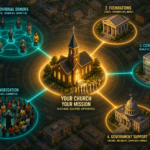
Right now — today — your church is leaving between $200,000 and $500,000 in accessible funding uncaptured every single year. Not theoretical money. Grants already allocated for faith-based organizations doing exactly what your church is doing. Major donors in your community giving $500 a year who have the capacity and the heart to give $5,000 if someone was intentionally cultivating that relationship. Corporate partners and government programs that funded the organization down the street simply because they showed up consistently and your church was busy running the spring campaign.
That gap has a price tag. Your board just has not seen the invoice yet.
When you walk into that room do not lead with what this costs. Lead with what staying where you are is already costing you. Those are two very different conversations.
How to answer it:
Bring the numbers. Research three to five grants your church is already eligible for. Add up the total potential funding. Put that number on a piece of paper and slide it across the table.
Then say: “This is sitting on the table right now. Every year we do not have the infrastructure to pursue it is another year it goes to someone else. The question is not whether we can afford to build this. The question is how long we can afford not to.”
Question 2: “What Is the Return on Investment?”
This is the question every board member is thinking even if they are not the one who says it out loud. And it deserves a direct honest answer.
Here is the direct honest answer.
The industry standard return on fundraising investment for organizations that build this right is four to ten dollars raised for every one dollar invested. Some organizations in the right conditions see it higher.
Let that land.
If your church invests $61,200 in a complete outsourced development department — and that team cultivates $200,000 in major gifts from donors already in your orbit, plus $100,000 in grants your church already qualifies for — you did not spend $61,200.
You made $238,800.
That is not a projection. That is the pattern we see inside every organization that builds this correctly and gives the system time to run.
And here is the part most boards never hear.
The return compounds. It is not a spike that resets after a campaign ends. Every donor cultivated this year is a deeper relationship next year. Every grant funded opens the door to the next cycle. Every major gift conversation that happens this year builds the credibility that produces a transformational gift five years from now.
Your board did not hesitate to hire an accountant to protect what the church already has. A fundraising infrastructure grows what the church is capable of building. Those are two different functions and both of them are essential.
How to answer it:
“The industry standard return is four to ten dollars for every dollar invested. But the more important number is this — we are currently leaving an estimated $200,000 to $500,000 on the table every year. That number compounds every year we wait. The ROI question cuts both ways. What does the investment return? And what does waiting cost us?”
Question 3: “Why Can’t Our Pastor or Staff Handle This?”
This one is personal. Because embedded in this question is an assumption that the church’s leadership has not been doing enough. That if they just worked a little harder or a little smarter the funding would follow.
That assumption is wrong. And it is important to say so clearly before you answer the question.
Your pastor is not underfunded because they are not working hard enough. They are underfunded because they are being asked to do two full-time jobs simultaneously — lead the congregation and personally carry the fundraising — and no single person can do both at the level they deserve to be done.
Think about it this way. You would not ask your CFO to also run your HR department. Not because they are not capable. Because each function requires professional-level focus and expertise and dedicated capacity to be done well. When you split that focus you get half a CFO and half an HR director and you pay the full cost of both gaps.
Fundraising is the same. Development done right is a full-time professional function. It requires specific expertise. Consistent execution. Year-round management of donor relationships, grant cycles, major gift cultivation, and institutional positioning. When that function falls on whoever has time this week it does not get done consistently. And inconsistent development produces inconsistent funding.
There is also a cost that rarely gets named in these conversations.
Every hour your pastor spends managing donor relationships, writing grant applications, planning fundraising events, and carrying the weight of the church’s financial future is an hour they are not spending on their calling. That is the most expensive exchange your church is making. And it is happening every single week.
How to answer it:
“Our pastor is one of the most valuable leaders in this community. Every hour they spend on fundraising is an hour they are not spending on pastoral care, on vision, on the congregation, on the programs we exist to run. Development done right is a full-time professional function. We would not ask our CFO to also run HR. Fundraising deserves the same professional standard.”
Question 4: “What Happens to Our Donor Relationships?”
This is the question pastors ask even more than board members do. Because for many pastors the donor relationships they have built over years are deeply personal. These are people who give because they trust the pastor specifically. And the idea of an outside team coming in to manage those relationships feels like a risk.
It is a completely understandable fear. And the answer is not what most people expect.
The churches that have built professional development infrastructure almost universally report that their donor relationships got stronger after the system was built. Not weaker.
Here is why.
Before the system your best donors hear from the church primarily when there is an ask coming. The relationship deepens somewhat but it deepens slowly because the pastor only has so many hours and so many relationships they can personally manage at one time.
After the system your best donors hear from the church consistently all year long. Not just when there is an ask. Updates on the programs they funded. Impact reports showing what their investment produced. Personal touchpoints that keep them emotionally connected to the mission between conversations with the pastor.
The pastor stays the face of everything. The relationship stays personal. What changes is that there is now a professional system running behind that relationship making sure nobody falls through the cracks. Making sure every donor feels genuinely cared for 365 days a year instead of three times a year when the campaign is running.
Your donors do not feel handed off. They feel more connected than they have ever been. Because someone is finally taking care of those relationships with the intentionality they have always deserved.
How to answer it:
“Our pastor stays the face of every relationship. Nothing changes about who our donors trust. What changes is that we now have a professional system making sure every donor hears from us consistently all year long — not just when we need something. Our donors will feel more connected to this church not less. Because the relationship is finally being managed the way it deserves to be.”
Question 5: “Will an Outside Team Understand Our Community?”
This is the most important question your board will ask. And it is the right question to ask.
Because the honest answer is — it depends entirely on who you bring in.
A generalist fundraising firm that adapted their model for African American churches is not the same as a team that was built exclusively for this community. The donor culture is different. The congregational dynamics are different. The community trust structures are different. The specific funders who prioritize faith-based community work in African American neighborhoods are different. These are not nuances you can learn from a handbook. They are things you understand from years of doing this work specifically in this community.
This is not a small thing. It is the difference between a team that treats your church like a client category and a team that understands your congregation the way an insider does. The difference between fundraising language that sounds institutional and fundraising language that sounds like it was written by someone who grew up in the church and knows what it means to hold this community’s trust.
When you bring in outside support the question your board should be asking is not whether an outside team can understand your community. The question is whether this specific team was built for your community. Whether this work is all they do. Whether they have a track record inside African American churches specifically. Whether the people doing the work understand the culture not just the strategy.
That is a higher bar. And it is the right bar.
How to answer it:
“This is exactly the right question to ask. Not every outside team is the same. The question is whether this team was built specifically for African American churches. Whether this community is all they do. Whether they have a proven track record inside congregations like ours. That is the standard we are holding this to. And it is the standard they need to meet before we move forward.”
One More Thing Before You Walk Into That Room
The board questions above are not the real barrier.
The real barrier is this — most boards make decisions based on what they can see clearly and what they can feel safely. A line item is visible and feels concrete. The $200,000 to $500,000 your church is leaving on the table every year is invisible because it is uncaptured funding — money that exists but never arrived.
Your job before you walk into that room is to make the invisible visible.
Bring the grants your church qualifies for but has never applied for. Bring the major donor giving levels and show the board what those numbers would look like if just ten percent of your donors were moved intentionally to the next giving tier. Bring the program your church has been trying to launch for two years that keeps getting delayed because the funding is not there.
Put a number on the gap. Name what the gap is costing the families your church exists to serve.
When the board can see what staying where you are is actually producing — and what moving forward actually makes possible — the conversation changes entirely.
The vision your church is carrying deserves the infrastructure to fund it permanently.
Your board is ready to hear that. They just need someone to walk them through it.
If you want to see exactly what this infrastructure looks like and how to present it to your board, watch the full video here
And if you are ready to talk about what the right development infrastructure looks like for your church specifically — book a free 15-minute strategy call with our team at wearenfm.com/contacts.