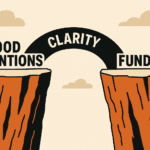

Across cities nationwide, Black pastors and nonprofit directors are working overtime to raise money for food pantries, youth programs, after-school tutoring, and community development. They’re hosting galas, fish fries, and GoFundMe campaigns with heart and hustle. Yet many of these organizations are unknowingly competing for the same limited pool of dollars.
It’s not for lack of faith or effort. It’s a structural issue. Funders often silo their giving, creating invisible walls between “church projects” and “nonprofit projects,” even when both serve the same people. Add that to the reality that only about 4% of total philanthropic funding goes to Black-led organizations, and you can see how competition within our community becomes a losing game.
When we compete instead of connect, everyone gets less. But when we unify strategy, share relationships, and co-create solutions, we change our entire funding landscape.
Why Competing Hurts Our Growth
Competition between Black churches and nonprofits often looks like:
- Applying for the same grants separately. Two organizations serving the same neighborhood submit similar proposals, splitting attention and diluting credibility.
- Guarding donor lists like secrets. Leaders fear that sharing contacts means losing donors, even though shared relationships often build stronger trust with funders.
- Duplicating services. Churches launch programs that nonprofits already offer, creating overlap instead of synergy.
- Overworking limited teams. Each organization does its own marketing, events, and reporting, wasting valuable time that could be used to collaborate.
Funders notice these patterns. When they see multiple small organizations working in silos, they often question capacity. They assume, “If these leaders won’t work together, maybe they can’t handle larger funding.” That perception keeps major money on the sidelines.
The Case for Collective Power
The history of Black progress has always been collective. From mutual aid societies to the Civil Rights Movement, unity has been our greatest multiplier. That same principle applies to fundraising and community development.
When churches and nonprofits align, they:
- Expand Eligibility for Larger Grants.
Some funding opportunities require partnerships or collaborations. A joint application instantly increases your credibility and reach. - Share Expertise.
A church might have community trust but lack grant-writing skills. A nonprofit might have strong data tracking but struggle with community engagement. Together, they fill each other’s gaps. - Leverage Resources.
One may own property, while the other brings program management. Shared assets create stronger proposals and more sustainable outcomes. - Build Donor Confidence.
Donors and foundations are drawn to collaboration because it signals efficiency and vision. When they see multiple trusted institutions united, it reassures them that their investment will have real impact. - Multiply Impact Without Multiplying Effort.
Instead of five small fundraisers raising $2,000 each, imagine one joint campaign raising $25,000 with shared promotion, volunteers, and media coverage.
Real Examples of Unity in Action
1. Shared Grant Strategy:
In Baltimore, several Black churches partnered with a local nonprofit to apply jointly for a community resilience grant. Each church took responsibility for a specific part of the project such as food distribution, youth programming, and workforce training. By combining their proposals into one coordinated plan, they secured nearly $750,000 in multi-year funding.
2. Collective Giving Circles:
In Atlanta, a coalition of faith-based leaders created a “Kingdom Impact Fund.” Each organization contributed a small amount monthly to build a shared reserve. They now co-fund emergency needs, launch pilot programs faster, and attract match funding from corporate partners.
3. Resource Exchange Networks:
A ministry in Chicago opened its building during weekdays to a local nonprofit that ran financial literacy classes. In return, the nonprofit included the church in its annual grant reporting as a partner site, helping the church gain visibility and credibility with funders for future projects.
Each example proves one point: unity expands capacity without extra cost.
How to Start Collaborating Right Now
Collaboration sounds big, but it begins with small, intentional steps.
1. Identify Overlap in Mission.
Look at who serves the same community. Are there nonprofits offering similar programs or churches leading outreach in the same area? Reach out to compare goals.
2. Create a Shared Funding Calendar.
Map out grant cycles and fundraising events in one shared spreadsheet. This prevents overlap and opens space for joint campaigns.
3. Exchange Donor or Funder Insights.
You don’t have to share entire lists. Start by discussing which types of funders (corporate, foundation, government) have been most responsive. This builds trust.
4. Host Joint Events.
A community breakfast, summit, or impact showcase featuring multiple organizations can double turnout and attract new funders.
5. Formalize the Relationship.
Once trust builds, create a Memorandum of Understanding (MOU) outlining how you’ll share resources, responsibilities, and credit. Funders love seeing documented partnerships.
6. Tell the Story Together.
Co-author op-eds, co-brand success stories, and share impact metrics as a united front. A unified story amplifies credibility.
The Cultural Shift: From Scarcity to Systems
Black leaders have historically carried enormous missions with limited means. The next chapter of progress depends on systems that multiply our impact, not strain it. Inter-organizational unity is that system. It transforms competition into capacity and scarcity into sustainability.
When churches and nonprofits collaborate strategically, they create an ecosystem where funding circulates within the community instead of leaving it. That’s how we move from surviving on offerings to building funding engines that power real transformation.
Next Step
If your organization is ready to strengthen its fundraising systems, deepen community partnerships, and start accessing larger funding opportunities, visit our Free Resources Page.
You’ll find practical tools and trainings that help Black churches and nonprofits move from one-time fundraisers to sustainable funding systems—designed specifically for leaders who serve our communities every day.
Because when we share knowledge and build together, our impact multiplies.